
In modern engineering, a single design point is not enough. A system needs to be robust and its response in a variety of environments and lifecycle states must be assessed. Parametric studies are now commonly performed but most solutions are based on external loops that prevent optimizing performance. This is how we optimize simulation wall time and storage. Our solutions for large numerical design of experiments come with controlled data volumes thus easier results browsing, a feature as important as the simulation itself!
Parametrized model reduction for fast reanalysis and compact storage
Given a system and a design space defining the considered parameters, the system response is evaluated as a response output to the specified inputs (that can also be parametrized).
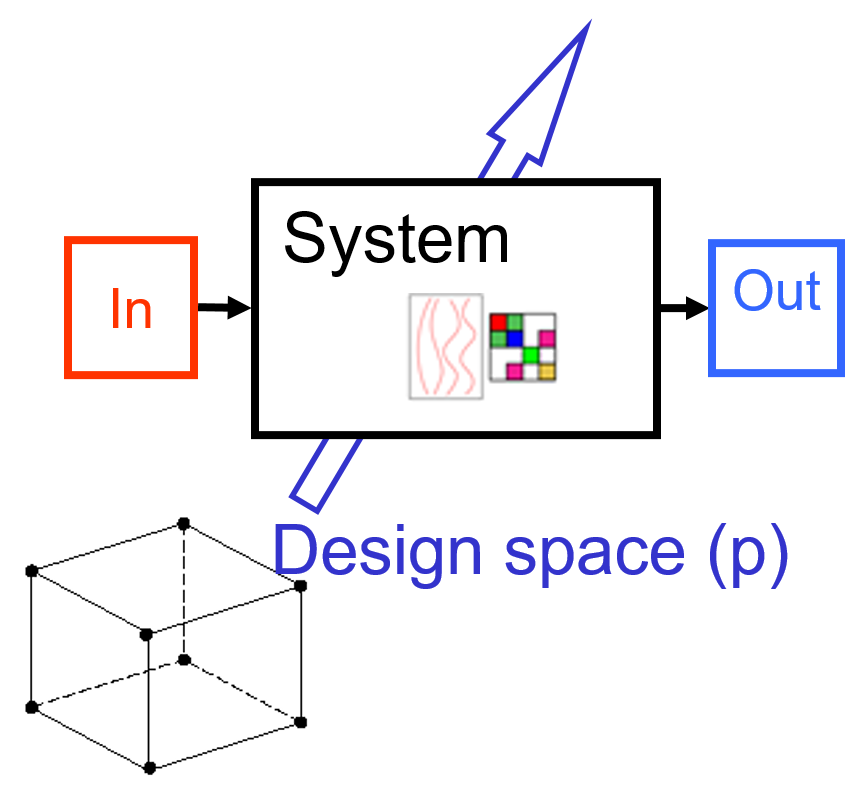
In classical vibrations the system is characterized by its modes or direct FRF responses. Non-linear response can be assessed usually by adding at least an input amplitude parameter and using dedicated simulation procedures to recover root locus trajectories or FRF. Using a linear reference case remains possible and constitutes a good basis for observation and characterization.
Projection and interpolation concept
Model order reduction by Ritz projection is an efficient procedure in vibrations, that can comprehend parametrization. Expressing system matrices into a parametrized weighted sum of nominal contributions:

The apparent constant DOF between configurations can be exploited to generate a common enriched reduction basis using selected learning points. The problem can thus be reduced once during an offline procedure, and then efficiently analyzed online to explore design points:

The enriched basis has the objective of interpolating the modeshapes associated with the interpolated matrices defined in the reference linear problem. For a non-linear pressure evolution case, the interpolation can be schematized as
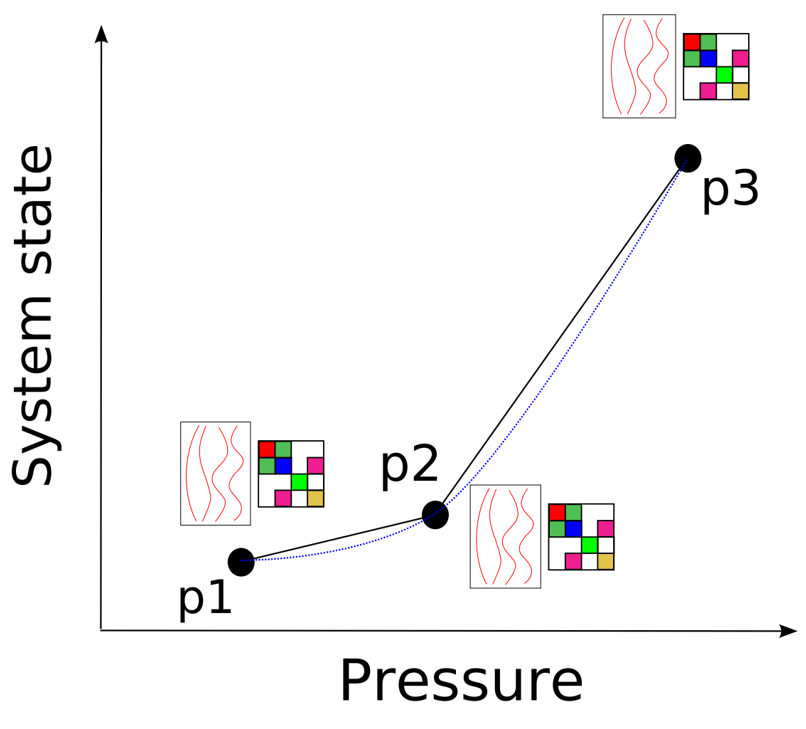
By doing so, reduction points solution is exact, and variations between design points are approached by a combination of every selected full design point. Optimal reduction basis generation is a key factor to success, with the possibility to automate for given classes of problems.
Expected simulation gains are drastic in terms of simulation times and storage. Modal analysis typically can pass from the hour range to the milli-second range, while storage will pass from the hundreds of GB to the GB range, or even less with potential optimization with restitution trade-off. Large numerical design of experiments spanning several thousands points becomes possible.
Large numerical design of experiments examples
The following example evaluated the squeal sensitivity of a 1.5 million DOF corner brake system to pad abutment sticking stiffness over a large frequency band. The property is uncontrolled as depending on the configuration a glued, free sliding or intermediate behavior (from dynamics effects) can happen. To properly understand such effect that will significantly alter modeshapes due to coupling, it is necessary to test a wide range of values with adequate discretization. A logarithmic variation of stiffness density between almost zero (1 N/mm²/mm) to very stiff 1010 N/mm²/mm) with 200 intermediate points is chosen.
The complete simulation procedure includes modal basis generation, system projection and reduced re-analysis. Considering 200 complex modes, it completed within 2 hours and generated 5GB of data. The results are sufficient to produce the parametrized root locus and restitute selected modeshapes on-the-fly for navigation and reporting.
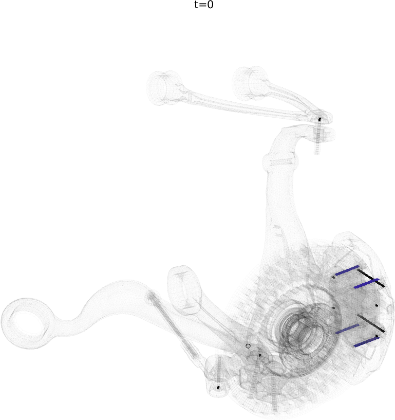
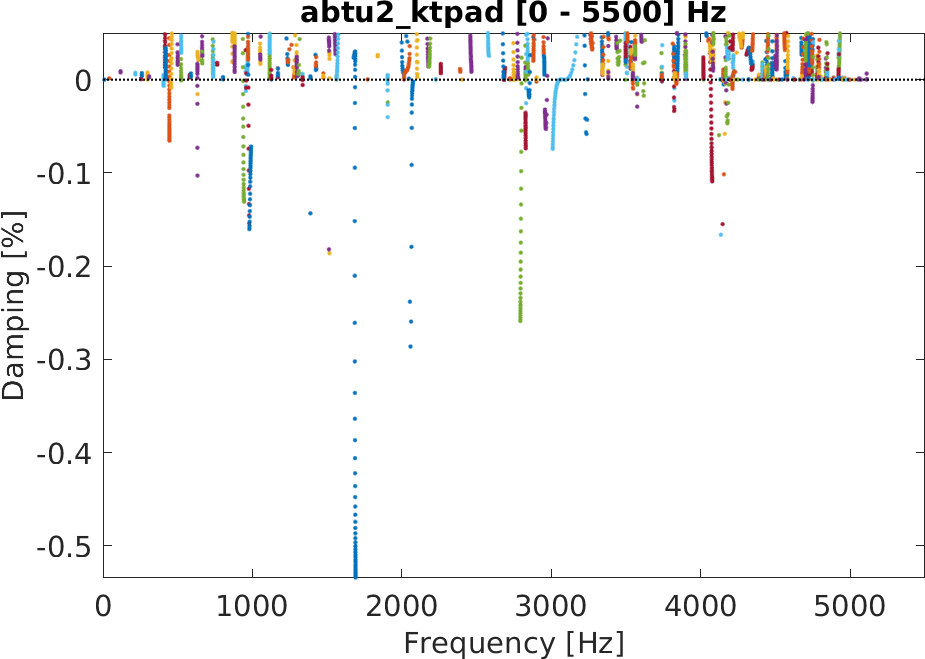
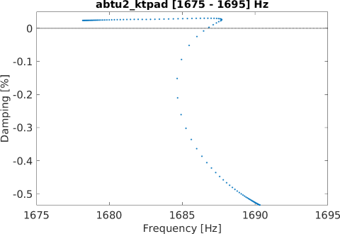
A full brute-force study would have generated over 900 GB and required between 10 and 20 hours to complete, excluding often consequent results file transfers from the servers. A storage reduction of 99.5% and simulation time gain of over 80% was thus achieved while enabling refined post-treatment.
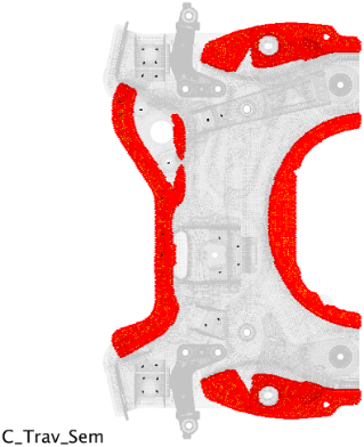
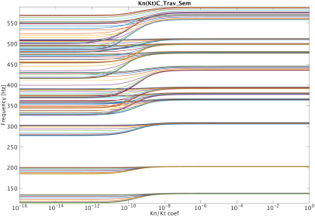
This second illustration studies the contact and friction properties between the two main plates of an automotive engine cradle. Behavior is unknown outside of weld points, test results showing that neither glued nor free configurations were realistic.
The proposed methodology simply selected every potential contact surfaces and varied contact and sticking stiffness in the frequency range of interest with a very fine parametric discretization. Passed saturated behavior that was not matching, mode ordering with correct frequencies could be recovered with updated coupling values.
Parameter space exploration and modeshape classification
The parametrized model order reduction method enables the generation of Design of Experiments (DoEs) over 10,000 points, that opens many exploration possibilities. When a significant number of parameters with wide ranges needs to be considered, adequate DoEs must be chosen. Traditional methods, simplex based or factorial schemes induce coarse or biased exploration.
Space exploration and beyond
In the following example, 5 parameters associated with contact and friction properties from glued to released were studied. With a scope of 10,000 points a factorial study allows 6 to 7 values, resulting in a very coarse factorial DoE. Setting up a Latin Hypercube Sampling for 10,000 points allows a refined discretization of each parameter and provides a much cleaner scan of the system’s behavior.
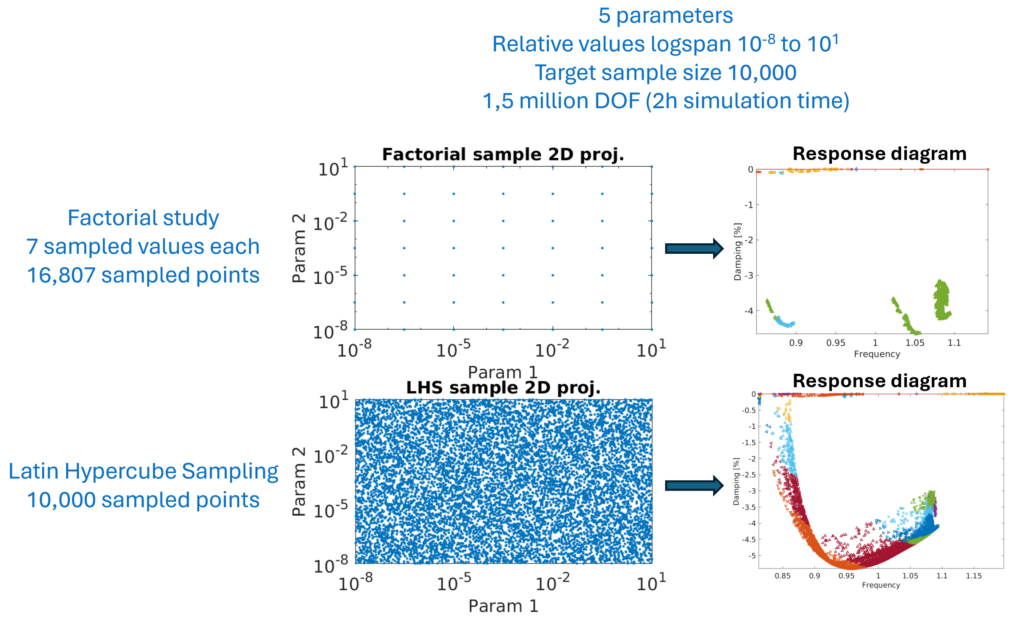
What seemed to be split behavior associated with specific frequencies was in fact a continuous transition of the same modal behavior. The ability to scale-up DoEs is thus critical to assess a modern system’s sensitivity.
Assessing the variability of the system’s characteristics over a large number of design points induces the need for adequate post-treatment methods. It becomes impossible to check every modeshape and their potential subtle variations, especially on large finite element models. Hence the need for mode classification methods.
Mode shape classification to master large numerical design of experiments results complexity
A mode classification method should not principally rely on frequency or damping regions. As soon as mode crossing, veering or coupling happens, distinguishing between modeshapes is critical. A classification using modeshapes is thus chosen, with a metric using subspace angles.
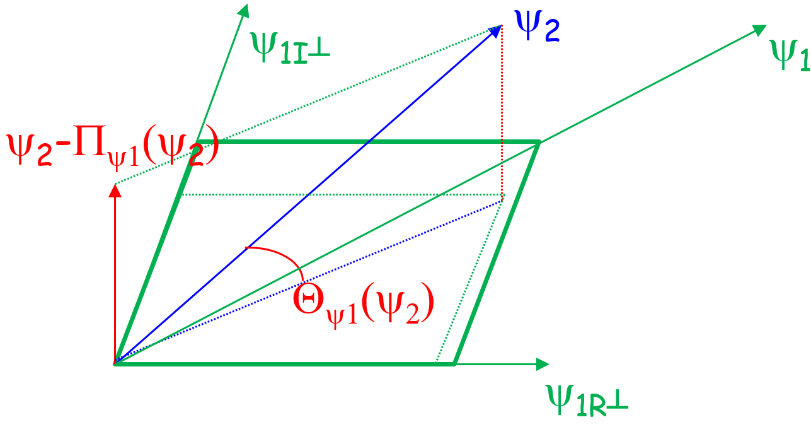
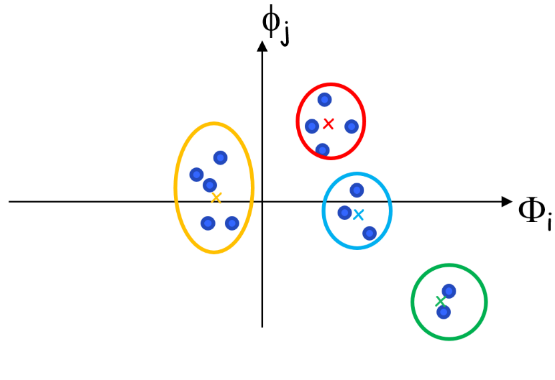
With such metric, distances can be evaluated and simple clustering methods such as the K-means become available to classify modeshapes. Depending on the frequency band of interest, complexity can be reduced to the analysis of a few cluster principal shapes.
Each design point being classified, associated parameter distributions are analyzed to assess sensitive parameters and understand trends. The results browser figure below illustrates how large DoE results can be investigated.
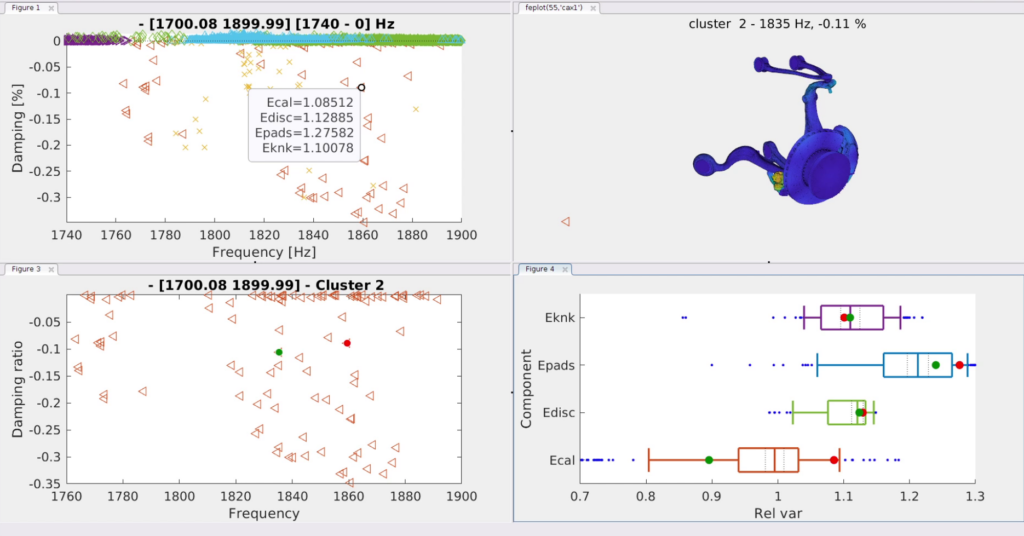
Global stability, selected cluster main shape, stability and parameter distribution with box plots.