Component Mode Tuning made easy
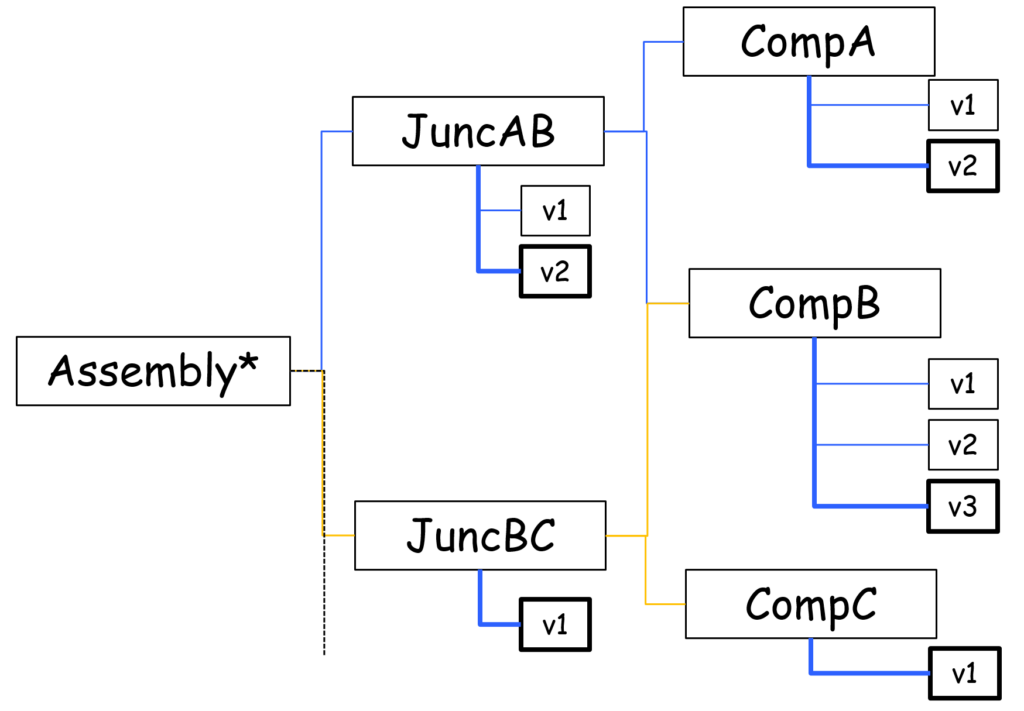
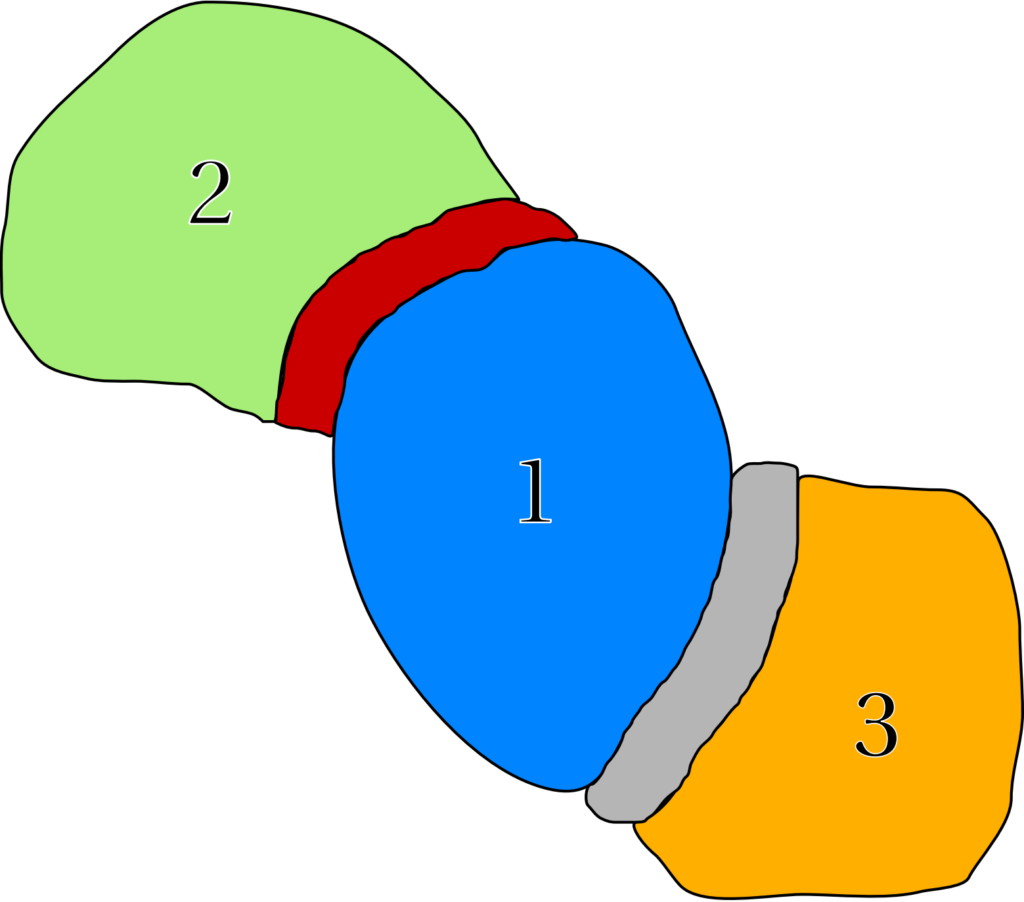
This module provides a framework to efficiently handle mechanical assemblies in SDT. A mechanical assembly is here understood as a series of components connected by linear(-ized) constraints (TIE/Glue, …) or possibly non-linear laws (contact, …).
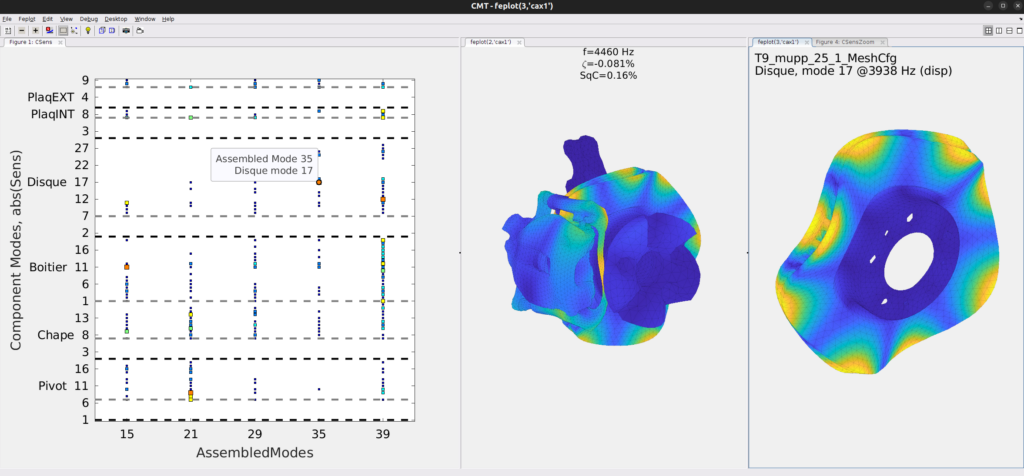
The Component Mode Tuning (CMT) method allows understanding component free mode energy contributions to a system mode. In large mechanical assemblies such as an automotive corner brake system, or when multiple modes interact when the frequency of interest increases, these contributions become non-trivial. A refined view such as the one presented below then becomes critically insightful.
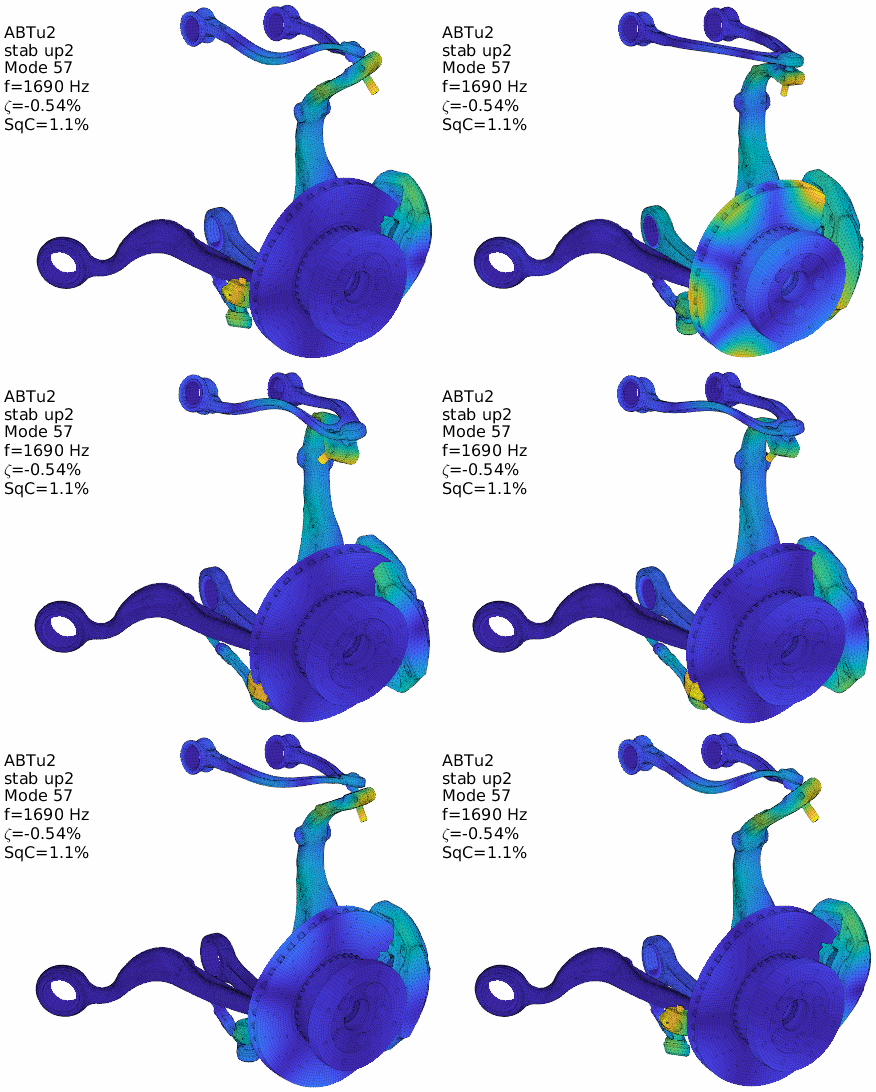
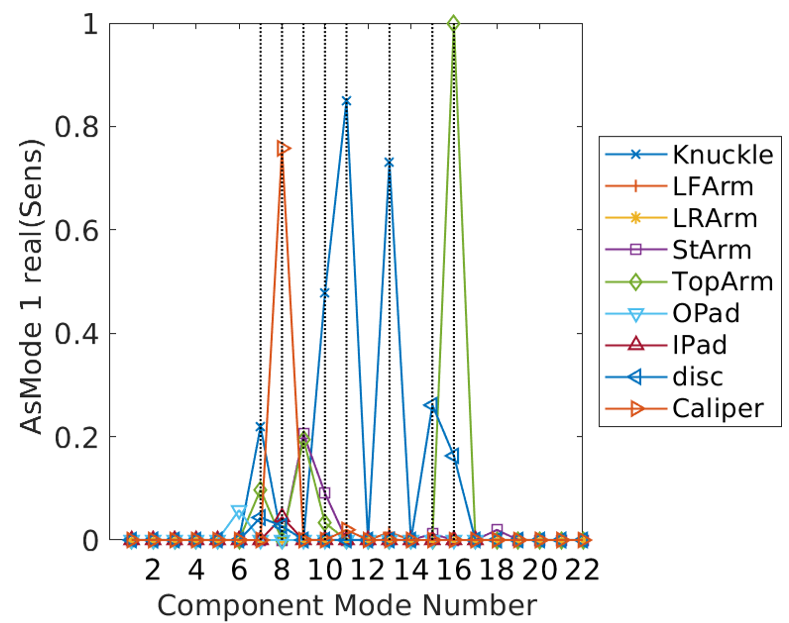
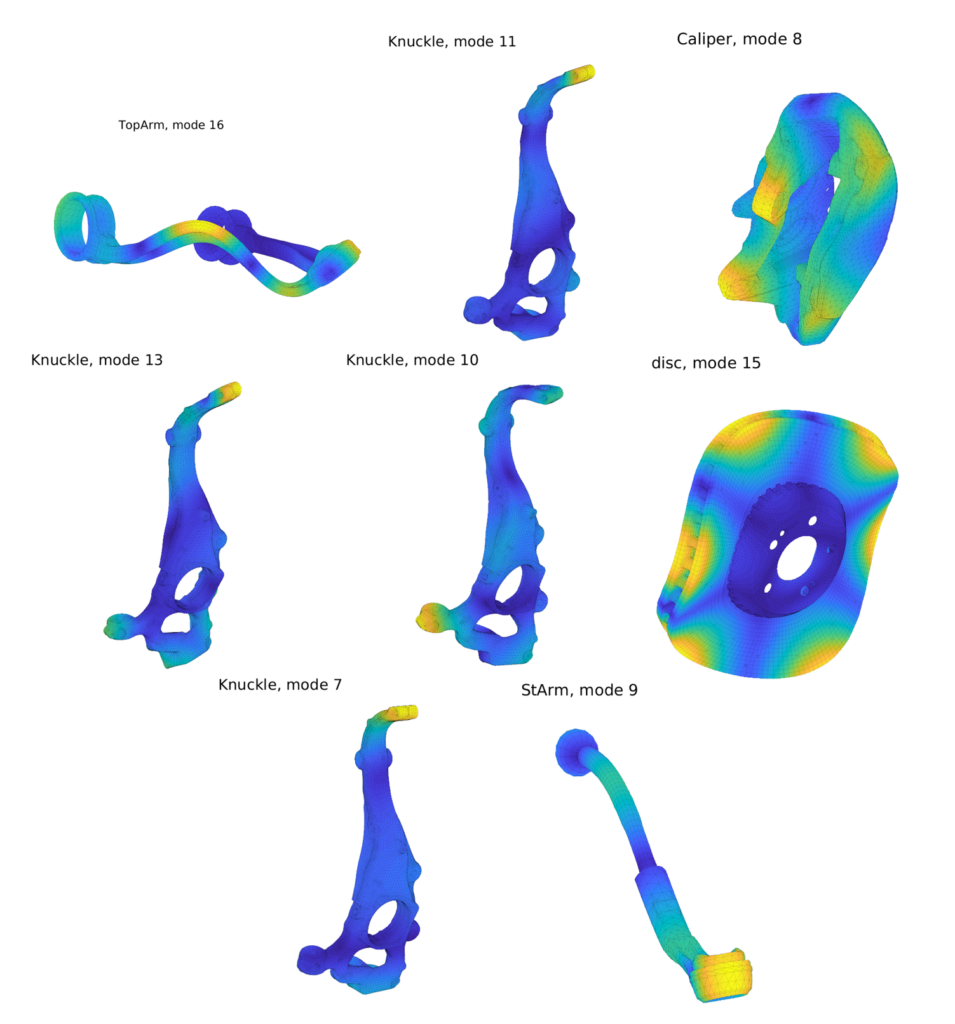
Based on observed sensitivities, it is possible to re-analyze with each free mode frequency variation. The CMT model being very compact, large Design of Experiments can be realized. This capability enables testing many solutions, or even global optimization. Mode tracking is thus possible, which emphasizes the CMT module originality in its ability to provide accurate insights into a complex mechanical assembly sensitivity to local component properties.
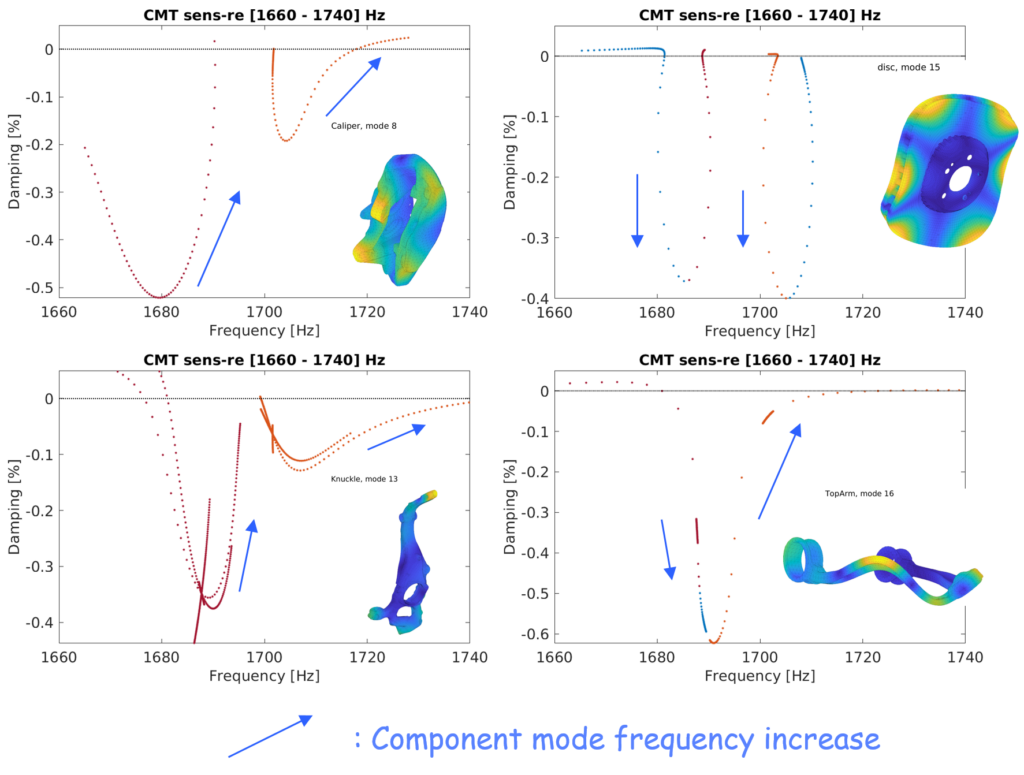
Target component frequency variation can thus be devised to orient redesign to counter for our example squeal occurrences.
This illustrative presentation covers the module’s basics associated with its original application. A variety of tools around the concept have been developed for component handing, parametric integration, and GUI handling from a generic Finite Element model.
A more detailed functionality list is presented below.
Pre-Processing
- Model linearization (boundary conditions and tangent states from non-linearities)
- Identification of kinematic coupling chains (series of 1D elements at component interfaces)
- Component list generation strategies through selection, recursive selection, completion, and integration of unselected areas.
- Component-wise reduction framework accepting ad hoc strategies (multi-modelling, contact based enhancement like KnKt, static capability, …)
- Component verification tools, independence and rigid body mode consistency checks.
- Component interaction verification tool, localization kinematics and flexibility evaluation.
- Component replacement integration, with interface coupling regeneration, support of reduced or full models.
- Integration of component connection studies, connection parametrization and pre-processing for KnKt studies.
- GUI implementation for study setup, and interactive component selection
Solver
- Generation of a self-contained reduced SDT model under CMT framework. Integration of HDF based saving and handles (Out-Of-Core data) to optimize memory.
- Parametric studies framework, design of experiment, second layer reduction strategies (when reduced component models account for many parameters), batch execution.
- Generation of KnKt studies for advanced cases
Post-Processing
- Model visualization with deformation restitution in feplot. Component based display selection possibly through GUI
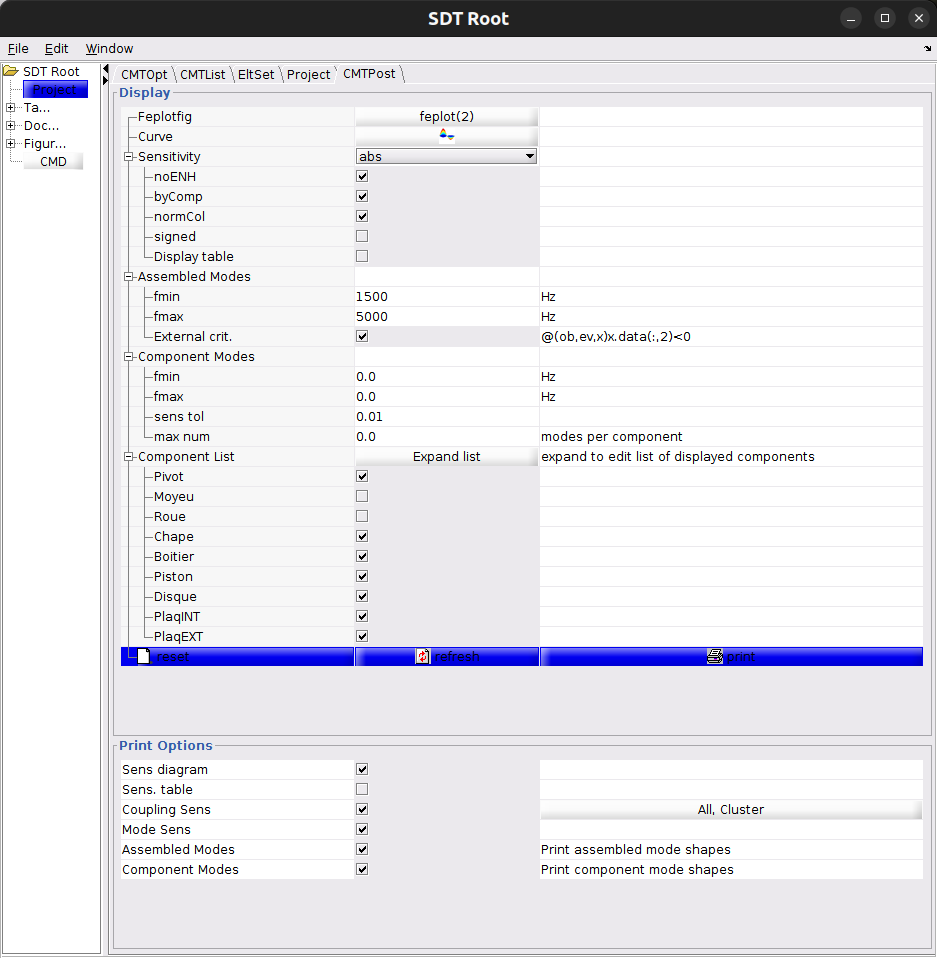
- Component mode and coupling sensitivity post-treatment with docked interactivity and automated report generation capability (selection possible through GUI).
- Energy distribution visualization and compatible with different selections.